


A critical vulnerability discovered in Mitel MiCollab could allow an unauthenticated attacker to execute commands with root privileges, highlighting how seemingly trusted certificate data can become an unexpected attack vector.
Synack Red Team researcher Mustafa Can Ipekci discovered the vulnerability while investigating what initially appeared to be a server-side request forgery issue in Mitel’s unified communications platform.
Instead, the investigation uncovered something significantly more serious: attacker-controlled information contained inside a TLS certificate could ultimately reach the operating system shell.
The vulnerability, tracked by Mitel as MTLVULN-1667, received a CVSS score of 10.0. Mitel patched the issue on June 17 as part of security advisory MISA-2026-0005.
A Certificate Became An Attack Vector
The vulnerability emerged from MiCollab’s handling of the Common Name field contained in a TLS certificate.
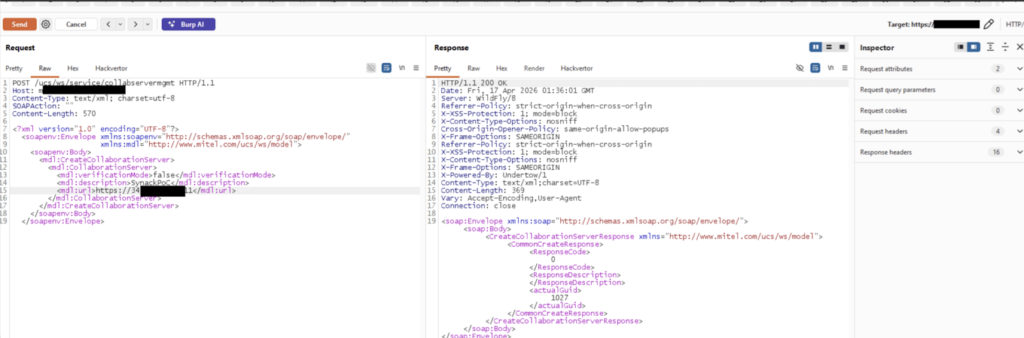
During testing, Ipekci discovered unauthenticated SOAP endpoints capable of instructing a MiCollab appliance to connect to an externally controlled server.
When MiCollab established the connection, it retrieved and processed the remote server’s certificate.
That created an unusual attack path. Rather than placing malicious input directly inside a web request, an attacker could place command syntax inside the Common Name of a certificate presented when MiCollab connected back to the attacker’s server.
The distinction matters for enterprise defenders because traditional request inspection may not see the malicious content.
The initial request sent to the MiCollab appliance can appear relatively ordinary. The dangerous input arrives later as part of the certificate exchanged during the outbound TLS connection.
From Certificate Validation To Root Access
Synack’s testing showed that MiCollab processed the attacker-controlled Common Name in a way that allowed shell command execution.
More importantly, the command executed before MiCollab finished rejecting the certificate.
Synack demonstrated that an unauthenticated attacker could trigger the behavior through two SOAP requests and ultimately execute commands as root on the appliance.
That makes the vulnerability particularly serious because exploitation does not require valid credentials or prior access to the MiCollab environment.
Mitel’s advisory says successful exploitation of MTLVULN-1667 could allow an unauthenticated attacker to execute arbitrary commands because of improper certificate validation. The company rated the vulnerability Critical.
Why The Attack Is Difficult To Spot
The research also illustrates a broader problem for enterprise security teams.
Security controls frequently focus on identifying malicious parameters, scripts or commands contained inside inbound requests. In this case, the command syntax does not need to appear there.
Instead, the malicious data is delivered through a certificate after the target system initiates an outbound connection.
That means signature-based inspection of the original request alone may not detect the attack.
For organizations operating communications infrastructure such as MiCollab, the vulnerability reinforces the importance of patching internet-accessible systems quickly while also monitoring unusual outbound connections and behavior from infrastructure appliances.
The Bottom Line
The Mitel MiCollab vulnerability is a useful reminder that trusted-looking data structures can still contain attacker-controlled input.
For security teams, the bigger lesson goes beyond one Mitel vulnerability. Applications increasingly communicate with external services, APIs and infrastructure automatically, creating attack paths that may not resemble conventional malicious requests.
Mitel has patched the issue, but organizations running affected MiCollab environments should make sure the relevant security updates have been applied. The discovery also gives defenders another reason to look beyond perimeter request filtering when evaluating how attackers could reach critical infrastructure.