By Rohit Gupta, CEO of Auditoria.AI
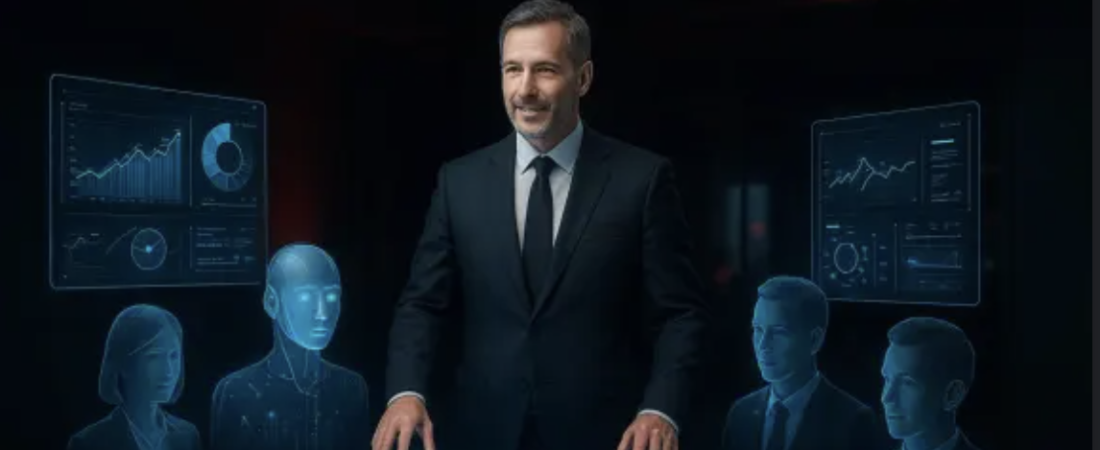
In the fantastical era of science fiction, the idea of a thinking digital replica of ourselves felt like something pulled from the pages of imagination. Someone who could make decisions for us or even anticipate our every move. But these days, that kind of magic is coming to the chief financial officer’s door. A new generation of AI is rising up that’s built not from passive automation software but through agentic design. An AI twin for the CFO and their team is being born.
Instead of rules-based systems that work from the outside in, agentic AI systems are aware. They learn through context, adapt to new conditions, and evolve with the finance function over time. Not just observing from the sidelines, but as a part of the daily beat. This is the era of the AI twin for finance.

Resource constraint – the CFO’s greatest challenge
Finance chiefs have no shortage of information. Today’s CFOs are drowning in data, dashboards and daily updates. The real bottleneck is capacity or the power to act on insight to execute decisions and drill down on anomalies or to pursue that vendor payment at the very moment it is needed the most.
In the past, this has required a finance team stretched to its limits, supplemented by rules-based automation. Helpful, but not thinking, reasoning or inquiring why a given discrepancy keeps showing up every month during reconciliation, or why there might be other issues with the potential to cause a last-minute fire drill. Imagine if your finance team had a second set of eyes and hands that never tire, miss a deadline, or lose context. Agentic AI can serve in that role.
Traditional automation operates on a binary logic: if X happens, do Y. It is a transactional event. By contrast, agentic AI is goal-driven. It doesn’t wait to be triggered. Instead, it acts with autonomy, navigating complex environments to fulfil objectives and reasoning through uncertainty. It is capable of evaluating risk and learning from outcomes.

Imagine a digital assistant that notices a vendor’s Days Payable Outstanding (DPO) is creeping up and initiates outreach before you even ask. Or an AI twin that sees patterns across purchase orders, approvals, and payments, highlighting inefficiencies or outliers before the quarter’s end. These are not just tools. They are team members in every sense of the word that learn from human inputs, shadow decisions, and eventually anticipate intent.
The magic of the AI twin lies in its capacity to mirror not just data workflows, but human decision-making. In practice, that means capturing how team members interact with vendors, how exceptions are handled, and what risk thresholds are tolerated.
Over time, this creates a sort of institutional memory, where the AI twin becomes an expert in the company’s financial DNA. For example, how are invoices prioritized, who is flagged for review, and what is normal or not. It does this continuously and in real time.
To share a potential situation of it coming into play, imagine a company with business operations in five geographies. They could use AI twins to localize financial operations, even as they apply group-wide standards. Each regional agent could train on its own financial ecosystem to manage vendor behavior, currency fluctuations, and local regulations while remaining in alignment with finance objectives across the group. The result is not just automation at scale but autonomy with accountability.

The beauty of this is that it does not stop there. Agentic AI participates in the process, communicating with ERP systems, tracking down missing documents, and resolving discrepancies without waiting for end-of-month crunches. It can escalate those items that need it, and resolve what it confidently understands.
Think about collections. In most organizations, receivables management is manual, inconsistent, and reactive. With an AI twin, that process becomes continuous. The agent identifies delinquencies, follows up, adapts tone based on prior response behaviour, and keeps a record of all interactions building a complete and searchable audit trail. Instead of pulling finance teams into the weeds of follow-ups and reconciliations, the AI twin gives them back the space to lead.
There’s an even more profound shift underway than just the improvement of operational efficiency. As AI twins take on routine and even complex transactional work, CFOs are liberated to step fully into the strategic partner role. The mental energy once spent on line items is redirected toward forecasting, scenario planning, and transformation.
Adding to this, AI twins are able to simulate decisions and run scenarios in parallel. What if we extend vendor terms by five days across the board or our collections team targets a different customer segment next quarter? The AI twin doesn’t just model the numbers, it reflects the judgment that underpins them because it has learned from your previous actions and decisions.
In this way, the twin becomes a co-pilot.
Of course, no CFO is looking to be replaced by a machine. And they shouldn’t be. AI twins don’t make strategic decisions in isolation. They don’t understand corporate culture, stakeholder nuance, or the weight of reputation. What they do is amplify the best of human capability which is speed, foresight, consistency and they do it without fatigue.
The companies that succeed in embedding AI twins into finance are those that treat them as collaborators, not substitutes. That means training them, refining their inputs, and reviewing their outputs regularly. It also means cultivating a finance culture that values experimentation and continuous learning.
What’s exciting is how fast this is evolving. In the space of a few years, we’ve moved from rule-based bots to autonomous agents capable of learning, reasoning, and interacting in natural language. As a result, CFOs today are meeting their digital doppelgängers and these twins are listening to the same meetings, analyzing the same data, and preparing to act before the month-end report is even compiled. It’s a moment of transformation that is not just for finance, but for leadership. Because when your twin can handle the process, you’re free to lead the change.

About the Author
Rohit Gupta is CEO of Auditoria.AI, an enterprise AI company focused on autonomous finance. He leads the development of agentic AI solutions that help finance teams automate accounts payable, accounts receivable, procurement, and financial operations while improving governance, efficiency, and decision-making.