
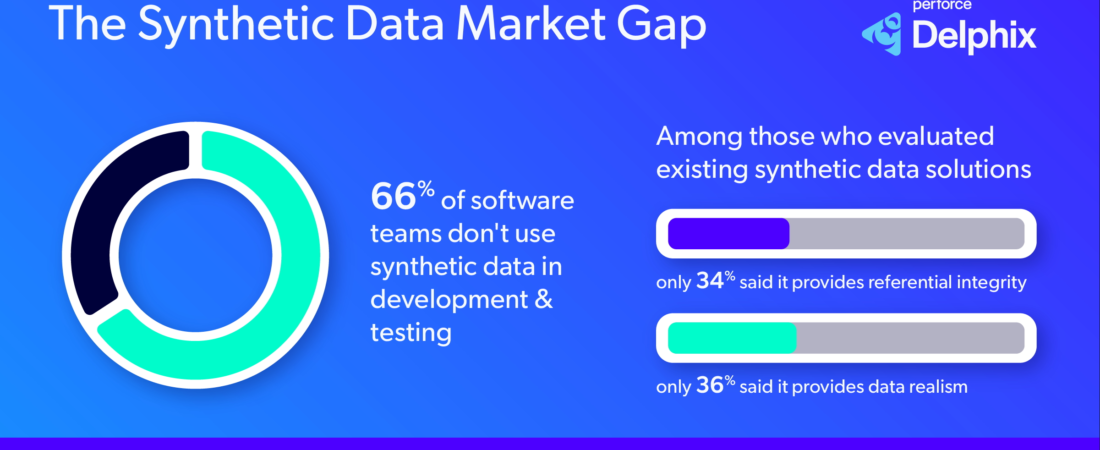
Enterprise software teams increasingly view synthetic data as a way to protect sensitive information in AI and development workflows, yet adoption and confidence remain uneven. The gap is consequential for IT leaders: test data must reflect complex business processes without exposing production records, but data that lacks realism or breaks relationships between systems can yield tests that do not reflect production behavior.
A recent Perforce survey of 518 enterprise technology leaders found that 66% of software leaders do not use synthetic data for development and testing, while only 36% of respondents evaluating the technology said it provides data realism and 34% said it preserves referential integrity.
The survey also found a disconnect between perceived suitability and deployment. Synthetic data was the top-ranked data-protection approach for AI and machine-learning workflows among 56% of respondents, but 51% said their organizations were not using it in those workflows. For IT leaders, that suggests interest in synthetic data is outpacing confidence in its quality, governance and ability to scale across enterprise environments.
The broader market includes specialist providers as well as broader test-data-management platforms. Tonic.ai offers synthetic data products for software and AI development, while GenRocket provides design-driven synthetic test data for enterprise testing teams. These vendors, along with Perforce, are addressing a common need: providing developers and testers with usable data when production data is restricted, incomplete or unavailable.
Against that backdrop, Perforce Delphix Synthetic Data is designed to generate realistic, scenario-specific test data while maintaining referential integrity across enterprise systems. Perforce said the product uses AI to scan metadata and schemas, identify data structures and relationships, and configure synthetic-data generation with less manual setup than conventional tools.
The company also highlighted that users can describe and modify desired data through natural-language prompts. The platform uses statistical analysis to assess data shape and distribution. Perforce is encouraging developers, testers and AI professionals working on new applications, features and other projects to consider the solution where usable production data may not exist.
Delphix Synthetic Data is part of the Delphix DevOps Data Platform, which combines synthetic-data generation with masking, data delivery and centralized governance. Perforce said developers and AI agents can access data through a user interface, APIs and MCP-enabled workflows. The company also said the product supports bring-your-own-LLM deployments so data remains within an organization’s infrastructure.

Jim Mercer, program vice president for Software Development, DevOps and DevSecOps at IDC, said: “Organizations need realistic test data that can be generated quickly, scale across complex environments, and meet data privacy requirements. Solutions like Delphix Synthetic Data that combine AI-driven automation with data quality and control are better positioned to address that need.”

Ilker Taskaya, field CTO for Perforce Delphix, said: “Your masked production data only tells you what already happened. Testing needs the cases that aren’t in production yet — and it needs them to hold together across every database and file format in the environment. Delphix Synthetic Data generates data in the shape teams specify, with referential integrity intact, so agentic development isn’t waiting on test data.”
For enterprise IT leaders, the launch reflects a broader shift in test-data management: synthetic data is moving from a niche alternative to a potential foundation for AI-assisted development. Perforce is positioning Delphix against legacy tools that require heavy manual configuration and customers will be looking for the product to deliver the realism, integrity and governance that the survey said the market has lacked.