
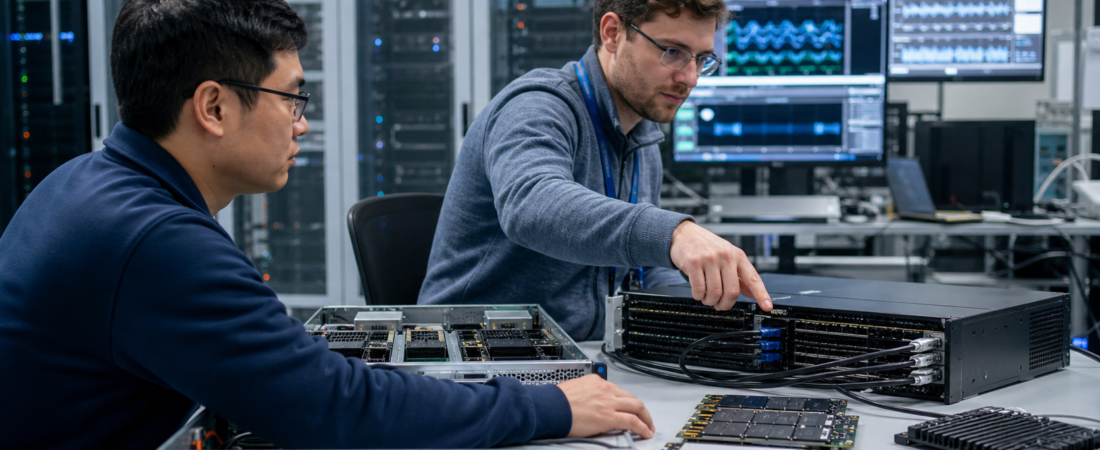
Microchip Technology and Micron Technology demonstrated an end-to-end PCIe Gen 6 storage architecture for AI, high-performance computing and cloud data center workloads.
The demonstration combines Microchip Switchtec PCIe Gen 6 switches with Micron 9650 NVMe solid state drives. The companies said the architecture is designed to increase bandwidth, lower latency and support scalable storage connectivity.
AI Workloads Stress The Storage Fabric
As AI models and data pipelines grow, storage architecture becomes more than a capacity question. Data centers need to move large volumes of data between processors, accelerators, memory and storage without creating bottlenecks.
PCIe 6.0 doubles PCIe 5.0 bandwidth to 64 GT/s per lane. That additional bandwidth is meant to support sustained throughput for AI training, real-time analytics, large databases and other data-intensive workloads.
Composable Designs Need Predictable Performance
At the 2026 Future of Memory and Storage Conference, the demonstration uses a Microchip Switchtec Gen 6 PCIe fanout switch as a high-bandwidth interconnect between host processors and multiple Micron 9650 SSDs.
Microchip said the architecture supports composable and disaggregated system designs, allowing data center architects to scale storage resources while maintaining predictable performance.
Security And Reliability Are Part Of The Pitch
Microchip said its Switchtec Gen 6 PCIe switches support high lane counts, error containment, diagnostics and multicast functionality for efficient one-to-many data distribution. The switches also include a hardware root of trust and secure boot architecture with post-quantum-safe cryptographic algorithms aligned with CNSA 2.0 standards.
Micron said its 9650 PCIe Gen 6 NVMe SSD is designed for high throughput, IOPS and low-latency workloads. Together, the companies are positioning the storage fabric as an ecosystem-level answer to AI infrastructure scaling.
The Bottom Line
Microchip and Micron are showing how next-generation PCIe switching and storage can support denser AI and cloud infrastructure. For enterprise data center teams, the issue is not just faster components. It is whether storage, switching, security and system design advance together enough to keep accelerators fed and workloads predictable.